ForbiddenPast
Ancient Wisdom
The shared spiritual inheritance. The same ground reached from many traditions, the same cataclysm remembered across cultures, the half of the story that was hidden, and the witnesses who were burned for telling the whole of it.
The Lineage, Told Four Ways
Strip the doctrine, and the same story keeps surfacing. Mystics from unconnected traditions describe the same ground. Cultures that never met remember the same flood. Every priesthood that codified scripture erased the feminine half. And the witnesses who told it whole were hunted for saying so.
Part I — The Shared Ground
What Every Mystic Agrees On
The Perennial Philosophy
Across cultures with no known contact, the deepest mystical texts keep converging on the same four claims. Strip the cultural dressing, and the core repeats. Aldous Huxley called it the Perennial Philosophy. He was pointing at something real.
1945 · The Book
Huxley’s Claim
In 1945, Aldous Huxley published The Perennial Philosophy, a book-length argument that the deepest mystical texts of every major culture — Vedanta, Mahayana Buddhism, Taoism, Sufism, Kabbalah, Christian apophatic theology, Pythagorean-Neoplatonic thought — converge on the same picture of reality. He called it perennial because it keeps reappearing, independently, as if deep contemplative practice inevitably ends up at the same view.
Huxley did not invent the idea. Renaissance humanists were using the phrase philosophia perennis in the 16th century. Leibniz picked it up. What Huxley did was build the strongest case on record by quoting directly from the mystical literature of each tradition and showing that once you translate between the vocabularies, they are making the same claims in different alphabets.
The Core
The Four Perennial Claims
Reduced to essentials, the perennial claims are four. Every serious mystical tradition makes some version of all four:
The material world is a derivative expression of a deeper reality
That deeper reality is more like mind or consciousness than like matter. Plato’s Forms. The Hindu Brahman. The Taoist Tao. Plotinus’s Nous. The Gnostic Pleroma. Kabbalah’s Ein Sof. Wheeler’s “it from bit.”
The individual self is not what it appears to be
The person you think you are — the memories, name, narrative — is a surface phenomenon. Beneath it is something that is not personal, not separate, not mortal. Hindu Atman as Brahman. Buddhist anatta (no-self). Sufi fana (annihilation in God). Meister Eckhart’s “ground of the soul.”
This deeper reality can be experienced directly
Not theorized, not believed — experienced. The point of contemplative practice is to remove the obstructions to that direct knowing. Hindu moksha. Buddhist nirvana. Sufi wajd. Zen kensho. Christian mystical union.
Ethics follows from this realization, not from rules
Compassion, non-attachment, and selfless action are not commandments you obey. They are the natural behavior of a being who has seen through the illusion of the separate self. If you still need rules, you haven’t seen clearly yet.
These aren’t loose thematic parallels. They’re specific claims about reality, repeating in the same shapes across cultures that had no contact. Either the contemplative mind keeps falling into the same illusion, or it keeps landing on something real. There’s no cheap third option.
East — Same Answer
Vedanta and Taoism — Nondual Without Knowing Each Other
The Advaita Vedanta tradition, formalized by Adi Shankara around 800 CE but drawing on Upanishadic material from 800 BCE, states the central claim as Tat Tvam Asi — “that thou art.” The individual’s deep self (Atman) is identical with the ground of reality (Brahman). Not related to it. Not united with it. You are already it. You just haven’t seen it yet.
The Tao Te Ching, written in China around 400 BCE without any known contact with India, makes the same claim in different language. The Tao that can be named is not the eternal Tao. Reality is one continuous process; you cannot grasp it from outside because there is no outside. The sage does not force or separate, because the separation itself is the illusion. India and China, a thousand years apart, no contact, same insight.
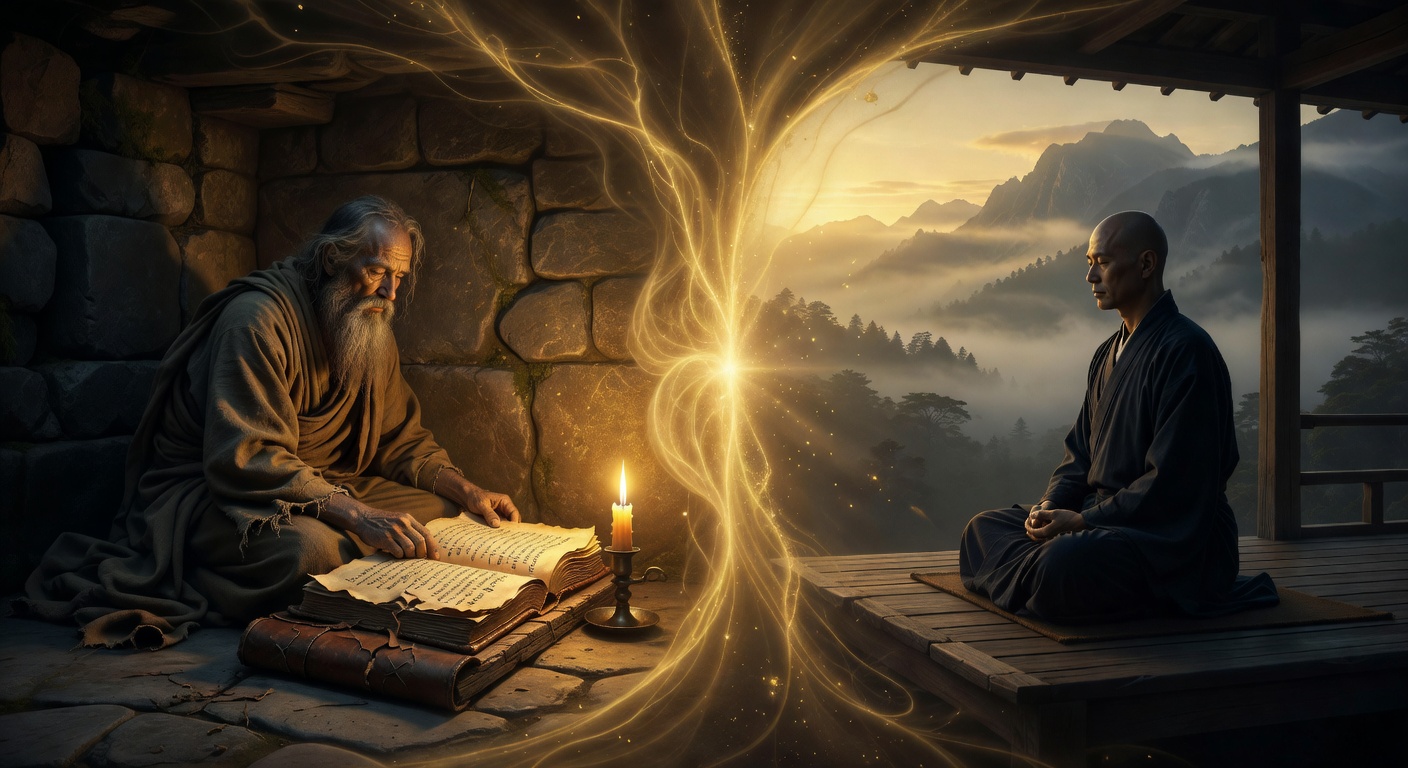
West — Same Ground
Meister Eckhart and Zen — Two Cells, One Silence
Meister Eckhart (1260–1328), a German Dominican friar, taught that the deepest level of the soul — what he called the ground — is uncreated and not distinct from God. The soul is not united with God through practice; it is already identical with the divine ground and simply has to let go of everything that isn’t. The Church tried him for heresy. He died before the verdict came down. His most dangerous line: “The eye with which I see God is the same eye with which God sees me.”
Zen Buddhism, developed in China and Japan with no knowledge of European Christianity, says the same thing in different words. There is no separate Buddha to become; you are already the Buddha, and must simply stop obscuring that fact with conceptual thinking. A famous Zen dialogue: “What is Buddha?” “Three pounds of flax.” That is not a riddle. It is an instruction to stop looking for Buddha somewhere other than here. Eckhart and Zen ended up in the same cell from opposite sides of the planet.
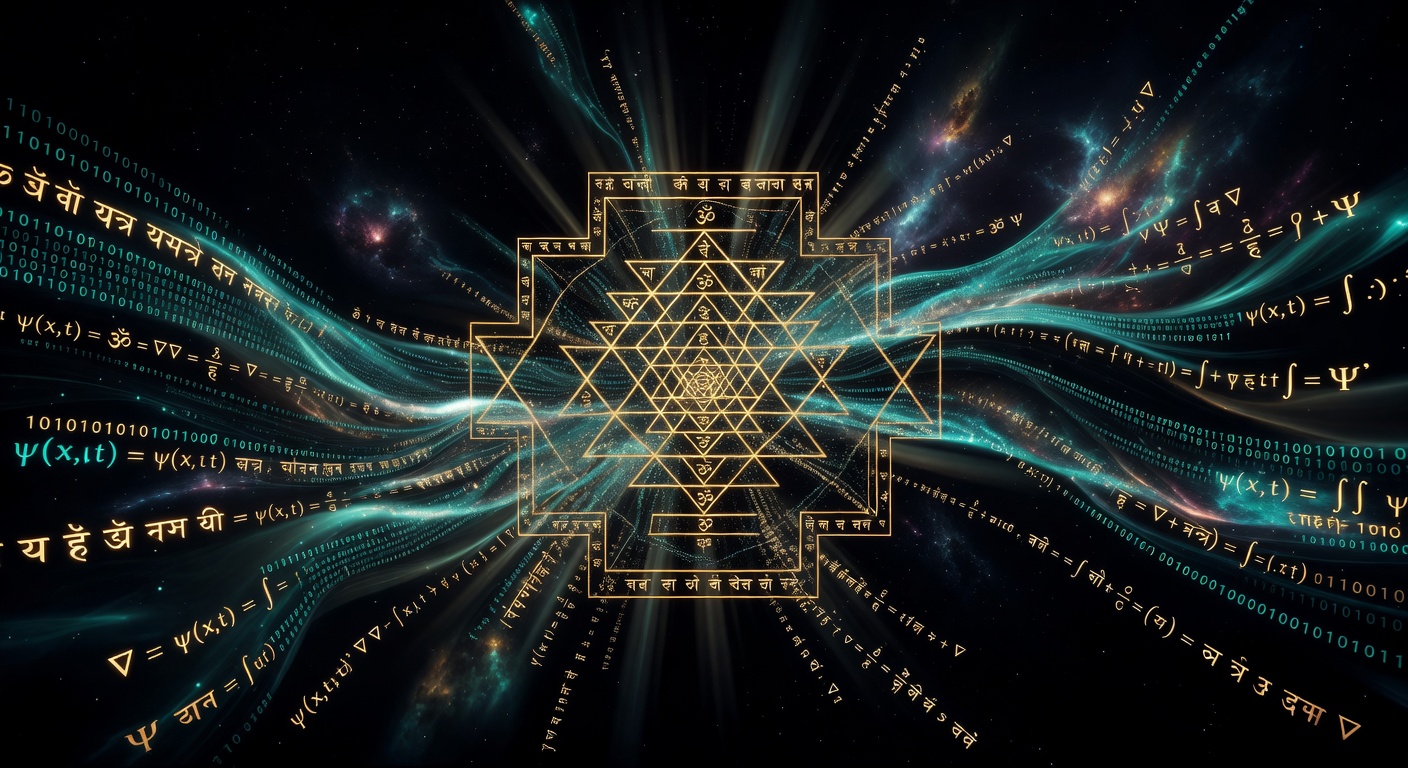
The New Convergence
Twentieth-Century Physics Walks into the Same Room
Nothing in Huxley’s 1945 book predicted that late-20th-century physics would produce its own version of the same claims. The holographic principle (Bekenstein, ’t Hooft, Susskind) says that all the information in a three-dimensional region can be encoded on its two-dimensional boundary — reality as a projection from a deeper informational layer. David Bohm’s implicate order maps the same structure onto quantum mechanics: the explicate world we see is unfolded from a deeper enfolded wholeness. Wheeler’s “it from bit” says information is primary and matter is derived.
None of these frameworks are ancient mysticism. They are mainstream theoretical physics, published in peer-reviewed journals, defended by Nobel laureates. But they are structurally identical to what the Upanishads said in 800 BCE, Plotinus in 250 CE, Nagarjuna in 150 CE, Shankara in 800, and Eckhart in 1300. Different vocabulary, same claim: the material world is a surface; something deeper is doing the work; that something deeper behaves more like information or mind than like stuff.
This is not a proof that the mystics were right. Structural parallels between physics and mysticism do not, by themselves, settle which one is correctly describing reality. But the parallels are specific, repeated, and getting sharper as the physics matures. At some point the “coincidence” story stops being the simpler explanation.
A century of physicists quietly reading Eastern philosophy
Bohr put the Taijitu on his coat of arms. Schrödinger cited the Upanishads by name. Zeilinger (Nobel 2022) sits with the Dalai Lama. A century-long conversation, mapped.
Rabbit hole detected
Deep dive →The Honest Position
What Huxley Was Pointing At
The perennial philosophy isn’t a religion. It’s not mushing everything together. It’s not a claim that all religions say the same thing — most of their surface content is culture-specific and often flatly incompatible. Christianity and Buddhism disagree about plenty. Islam and Vedanta disagree about plenty. The perennial philosophy is just what’s left once you strip the cultural clothing off the deepest mystical texts of each tradition.
What’s left is a specific claim about reality, repeated across traditions that never met, made in their own vocabularies, defended by their own arguments, and confirmed inside their own contemplative practice. And now the physics is producing a version of it too. The question is whether this match is pointing at something real, or whether the contemplating mind and the mathematical mind both keep sliding into the same human illusion when they go deep enough.
Our working position: science hasn’t closed the question, and the mystics haven’t either. What nobody can dismiss is that the pattern is real. The Upanishads, the Tao Te Ching, Plotinus, Eckhart, Zen, Sufi poetry, Kabbalah, and modern information physics are all pointing at the same thing. Either that thing is an illusion the human brain keeps falling into, or it’s what honest deep looking keeps turning up. Huxley didn’t know which. We still don’t. But the match is real, and it’s the most interesting pattern in the history of human thought.
Sources & Further Reading
- Aldous Huxley — The Perennial Philosophy (1945) — the book-length case for mystical convergence across traditions
- Adi Shankara — Advaita Vedanta (c. 800 CE) — formalized the nondual “Tat Tvam Asi” teaching from the Upanishads
- Lao Tzu — Tao Te Ching (c. 400 BCE) — Chinese nondual philosophy with no contact with Indian thought
- Meister Eckhart (1260–1328) — German Dominican mystic tried for heresy over nondual claims
- David Bohm — Wholeness and the Implicate Order (1980) — quantum physicist’s framework paralleling mystical nonduality
- Bekenstein, ’t Hooft, Susskind — Holographic Principle — reality as projection from a deeper informational layer
- John Archibald Wheeler — “It from Bit” (1990) — information as the fundamental substrate of physics
Part II — The Shared Memory
Why Every Culture Tells the Same Story
The Flood Memory
More than 200 cultures on every inhabited continent preserve essentially the same story: catastrophic flood, small band of survivors, warning, boat, rebuilt world. They were not inventing in parallel. They were passing down what happened.
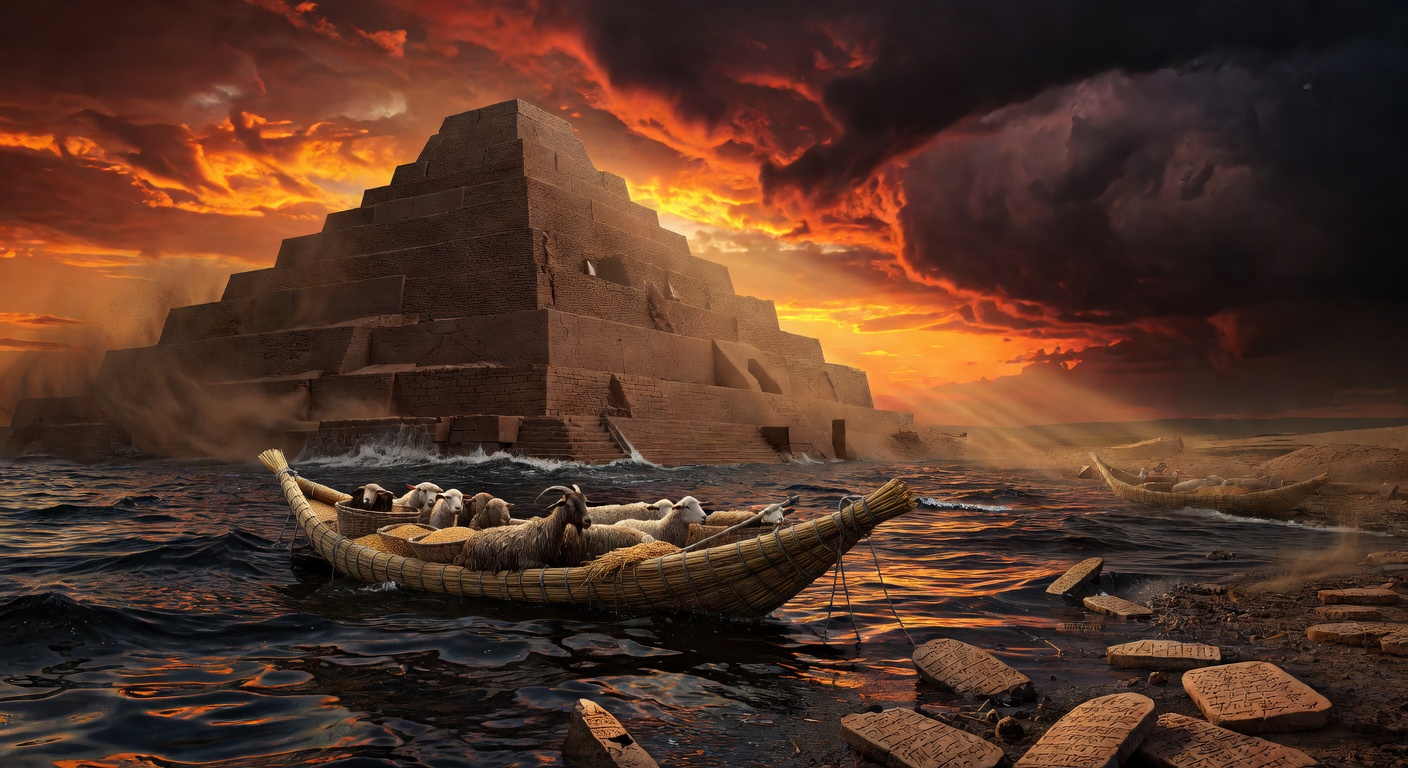
The Lineage
Ziusudra → Utnapishtim → Noah
The oldest recoverable flood story is Sumerian: Ziusudra (“he of long life”), pious king of Shuruppak, warned by the god Enki through a reed wall to build a great boat and save his family, the animals, and the seeds of every living thing. The story was already ancient when Sumer first wrote it down around 1600 BCE.
The Akkadian Atrahasis Epic (c. 1700 BCE) retells it with the hero renamed. Tablet XI of the Epic of Gilgamesh (c. 1200 BCE) retells it again, this time with Utnapishtim. Then the Genesis flood narrative lands, with Noah in the role the Sumerians had been describing for a thousand years. The lineage is airtight. Genesis is not the original — it is the last surviving stop in a chain of transmission at least 4,000 years long.
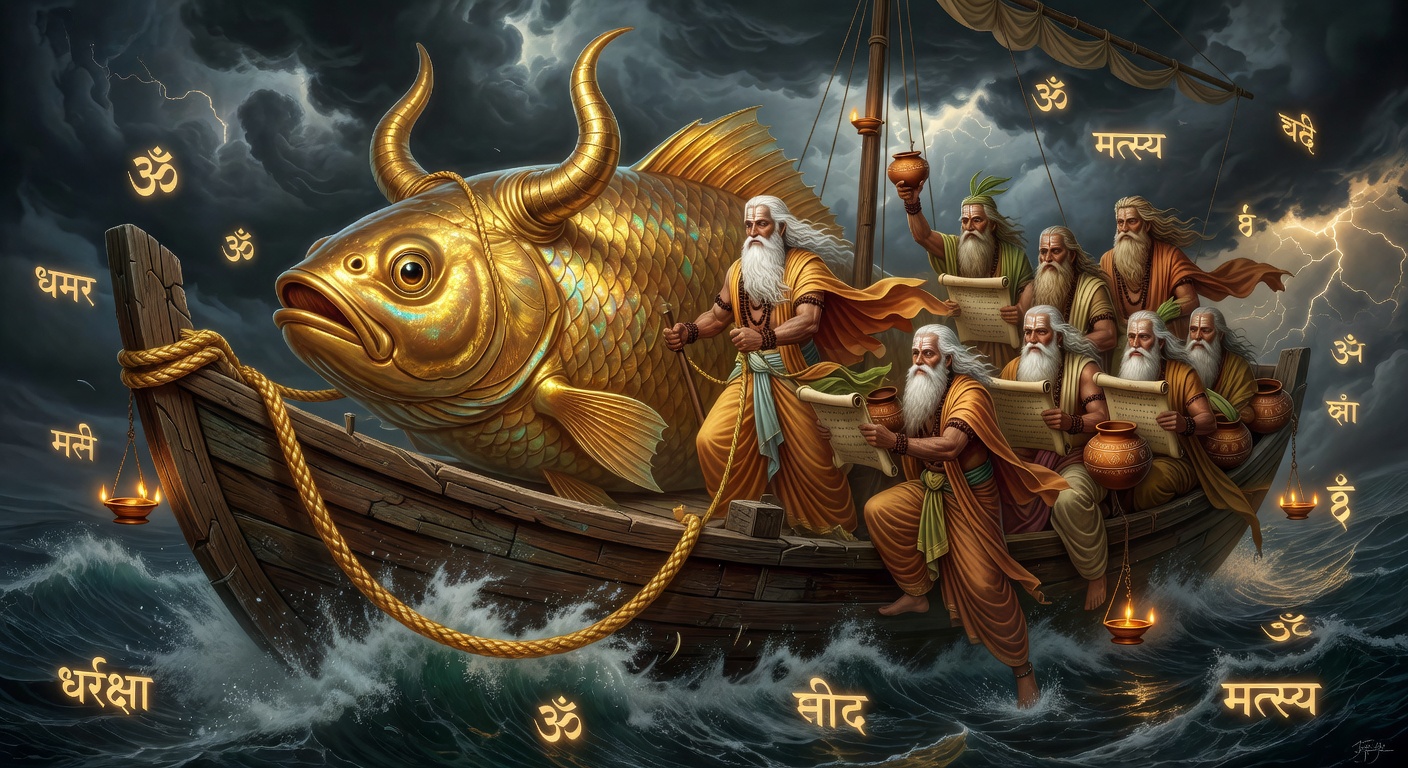
The Indian Version
Manu and the Fish
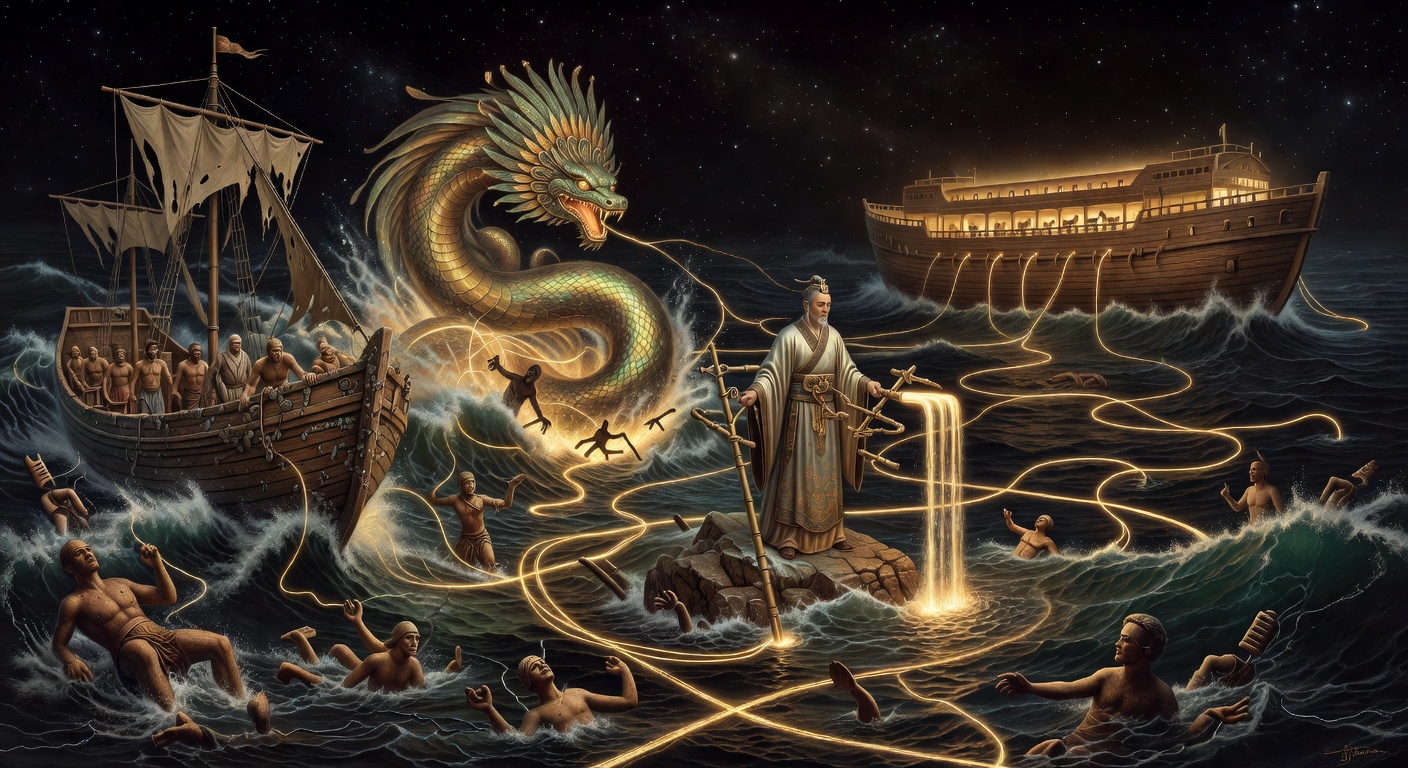
The Indian flood story predates the Hebrew one by a comfortable margin. The Shatapatha Brahmana (c. 700 BCE) tells of Manu, the first man, who one morning finds a small fish in his bathing water. The fish asks to be protected. Manu moves it into a bowl, then a larger vessel, then a river, then the ocean, as it keeps growing. When it is too large for the sea, it reveals itself as Vishnu in his Matsya avatar, come to warn Manu that a flood will destroy the world.
Manu builds a boat, gathers the seven sages (Saptarshi), the seeds of every plant, and one of every living creature. The fish, now enormous, tows the boat through the floodwaters by a rope tied to its horn and beaches them on a northern mountain. The story is older than Genesis, structurally the same as Ziusudra’s, and it was written down in a region that had no way to trade notes with Mesopotamia at the time.
The Cross-Cultural Pattern
Four Continents, Same Story
The Near East is one thing — Sumer, Babylon, and Canaan/Israel were in constant cultural contact. But flood stories show up everywhere, including in cultures that had no possible link to the Mesopotamian tradition when their versions crystallised:
Greece · ~8 CE
Deucalion and Pyrrha
Zeus floods the earth in disgust at humanity’s wickedness. Deucalion, warned by his father Prometheus, builds an ark. After the waters recede, he and his wife repopulate the world by throwing stones behind them.
China · ~1000 BCE
Gun-Yu
The great flood of Chinese tradition, solved by Yu the Great who spent years channeling the waters to the sea. His success founds the Xia Dynasty. The 2016 Wu et al. paper in Science dated a real catastrophic flood on the Yellow River to ~1920 BCE that may match the tradition.
Mesoamerica · Pre-Columbian
The Popol Vuh’s Failed Creations
The K’iche’ Maya creation epic describes three failed attempts to make beings capable of worshipping the gods. The third attempt — wooden men — was destroyed by a great flood. Only afterward were true humans made from maize.
Aztec · Pre-Columbian
Nahui Atl — Four Water
The fourth of the five Aztec suns was destroyed by a great flood. Survivors Tata and Nena escaped in a hollowed-out cypress tree. The fifth sun — the one we live in now — began after the flood receded.
Greeks never spoke to Maya before 1519 CE. Chinese never spoke to Aztecs. And yet the same core story — flood, righteous survivor, boat or tree, rebuilt humanity — turns up in every one of them.
Memory That Survived
Aboriginal Australia — 7,000 Years of Oral Memory
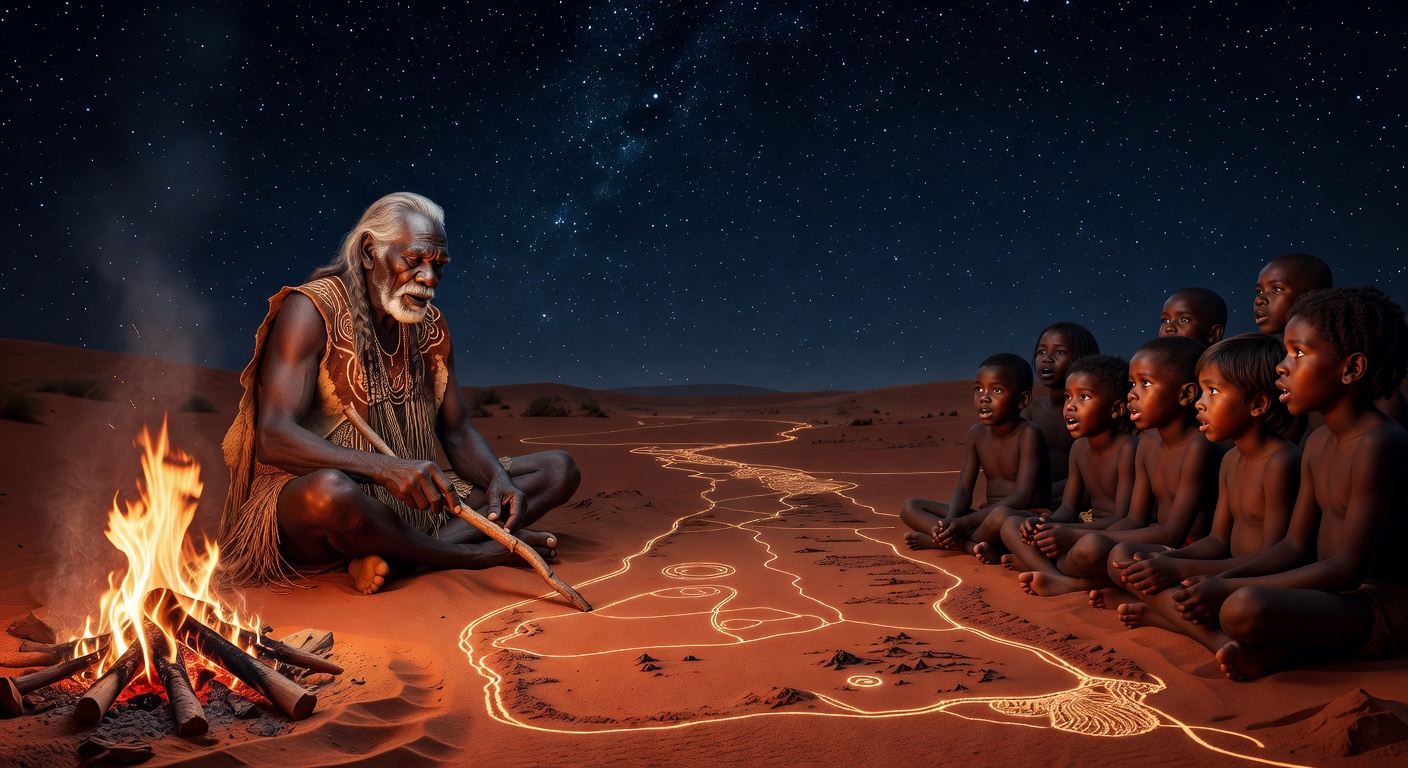
In 2015, linguist Nicholas Reid and geographer Patrick Nunn published a paper in Australian Geographer that changed how scholars think about oral tradition. They identified at least 21 Aboriginal Australian traditions that describe specific geographic features — offshore islands, former landmasses, precise distances between landmarks — matching the Australian continental shelf before the post-glacial sea-level rise.
These aren’t mythic descriptions. They are accurate memories of coastlines that have been under water for 7,000 to 12,000 years. The stories survived through ritual, songlines, and strict teaching rules passed down the generations — carried faithfully across more than 280 generations. If Aboriginal Australians can remember the sea rising, the fact that every other culture also remembers it — at different dates, in different images — stops being a mystery. The sea really did rise, violently, at the end of the last ice age. The survivors told their children, and some of those children are still telling the story.

What the Stones Say
The Younger Dryas — What the Myths Remember
Geology and mythology agree on one specific event. Approximately 12,900 years ago, the Northern Hemisphere climate flipped from warming to ice-age conditions inside a single human generation. The Clovis culture dropped out of the archaeological record. Pleistocene megafauna went extinct across North America and northern Eurasia. 1,200 years later, the cold ended just as abruptly. This is the Younger Dryas, and it is the most dramatic climate event of the last 50,000 years.
What caused it is contested. The mainstream reading blames meltwater pulses from the collapsing North American ice sheet shutting down the Atlantic currents. The Younger Dryas Impact Hypothesis argues a comet or asteroid broke up over the Laurentide ice sheet and kicked the climate over. The case rests on what’s in the dirt at the 12,800-year layer on multiple continents: a spike in iridium, tiny diamonds made by huge heat and pressure, small glass beads from melted rock, and a dark charcoal band called the “black mat.” A ~31 km crater was found under the Hiawatha Glacier in 2018 and briefly held up as the smoking gun — later redated in 2022 (Garde et al., Science Advances) to around 58 million years old, which takes the crater out of the argument. The stuff in the dirt is still there and still unexplained.
Either way, something violent happened, people saw it, survivors told their children, and the story made it all the way down to Sumer, Genesis, and the Popol Vuh, where the original event got wrapped in layer after layer of theology and moral framing. The core survived all of them. The world ended. A few were warned. A boat was built. The animals were saved. The waters came and went. A new world began.
The Honest Position
What We Can Actually Say
Not every flood myth is remembering the same event. Mesopotamia had real, recurring river floods. The Indus Valley had real flood disasters. Some flood stories are just local catastrophes blown up into legend. Some may be made up fresh — people live near water, and floods are terrifying.
But the pattern across continents that never met is too specific to wave away. The Reid–Nunn Aboriginal evidence alone proves that accurate geographic memory can survive 7,000+ years of passing it down by mouth. The Younger Dryas is a real, dated, catastrophic event in the rocks. And the same core story — flood, warning, ark, animals, survival, rebuilt world — keeps showing up in cultures that had no way to share notes.
The honest position: something real happened at the end of the last ice age, violent enough to end a civilisation or several, and widespread enough to be seen and remembered across continents. The specific myths we have today are distorted, moralised, and embroidered. They still point at the same event. Either every culture independently invented the same story, or they’re remembering the same thing. The second is simpler than the first.
Ziusudra, Noah, Manu, Deucalion, Gun-Yu, the Popol Vuh — mapped
Two hundred cultures, one story. The full deep dive: George Smith’s 1872 discovery, Reid-Nunn 2015 on Aboriginal memory, Wu 2016 on the real Chinese flood, Firestone on the Younger Dryas.
Rabbit hole detected
Deep dive →Sources & Further Reading
- Ziusudra — Sumerian flood narrative (c. 1600 BCE) — the oldest recoverable flood story
- Atrahasis Epic (c. 1700 BCE) — Akkadian retelling of the Mesopotamian flood
- Epic of Gilgamesh, Tablet XI (c. 1200 BCE) — Utnapishtim’s flood account
- Popol Vuh — K’iche’ Maya creation epic with flood-destruction of the third creation
- Wu et al. — “Outburst flood at 1920 BCE supports historicity of China’s Great Flood and the Xia dynasty” Science (2016) — geological dating of the Yellow River flood tradition
- Nunn & Reid — “Aboriginal Memories of Inundation” Australian Geographer (2015) — 7,000+ years of accurate oral memory of sea-level change
- Younger Dryas Impact Hypothesis — the case for a cometary airburst triggering the YD event ~12,900 BP
Part III — The Hidden Half
The Other Half of the Story
The Hidden Feminine
The sacred feminine was systematically erased from the religions that won. She keeps surfacing anyway — as Sophia, Shakti, Shekinah, Mary Magdalene, the Black Madonnas. Every tradition kept something back.
Wisdom as a Person
Sophia — The Fallen and Returning Divine Feminine
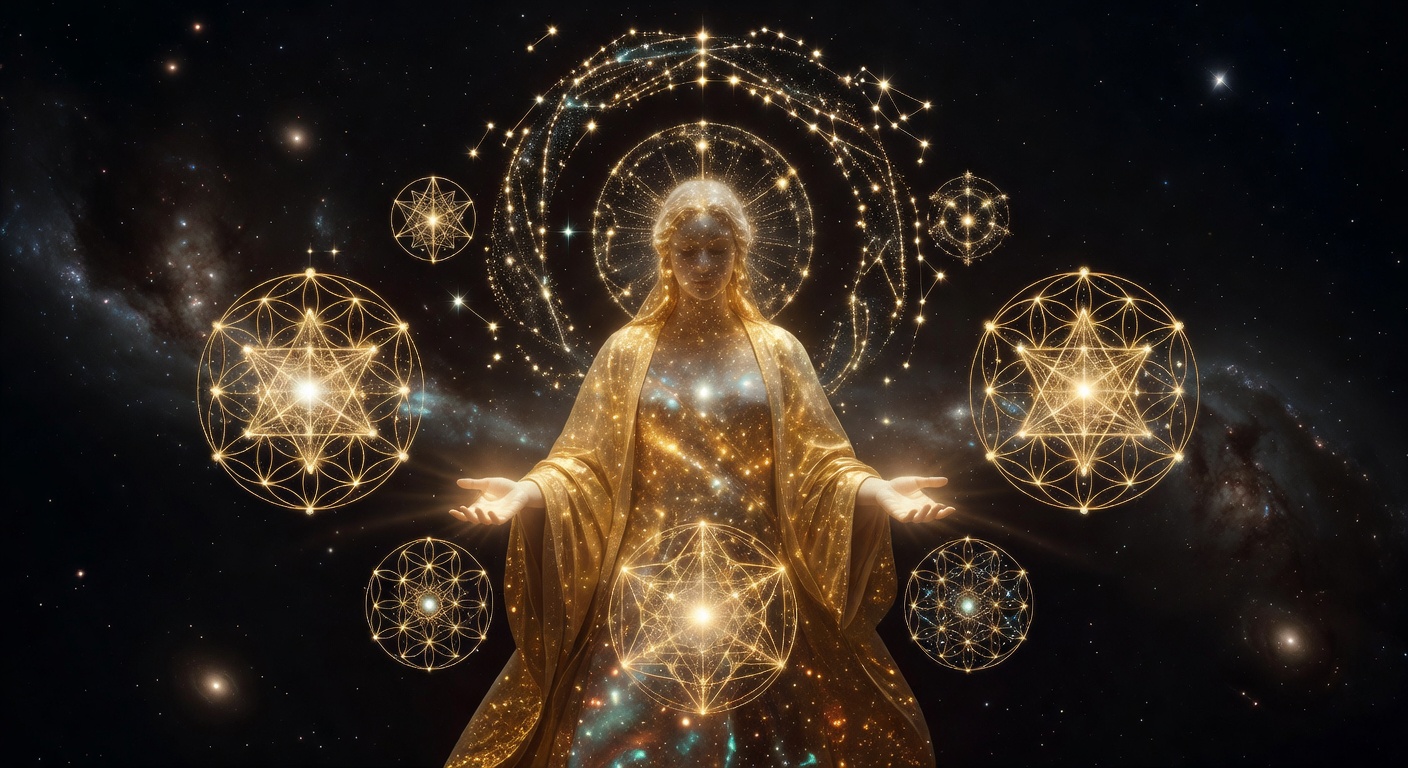
In Gnostic cosmology, Sophia (wisdom) is not an abstract attribute. She is a person — the youngest of the divine emanations in the Pleroma, who tried to know the ineffable Father directly, overshot, and fell. Her fall is how the material world comes into being. Her return is how it is redeemed. The Secret Book of John makes her the mother of the Demiurge; the Pistis Sophia tells the long story of her exile and rescue.
This is not a minor theological footnote. In Valentinian Gnosticism, the entire cosmic drama is Sophia’s story. The Demiurge is her mistake. Christ is the one who comes to bring her back home. Creation begins with a feminine divinity getting it wrong and ends with her being reintegrated — a mythological structure radically different from the masculine father-creator that won the Council of Nicaea. The full Gnostic cosmology — from the Monad through Sophia’s fall to the Demiurge — is explored on Deeper.
The First Disciple
Mary Magdalene — The One Who Understood
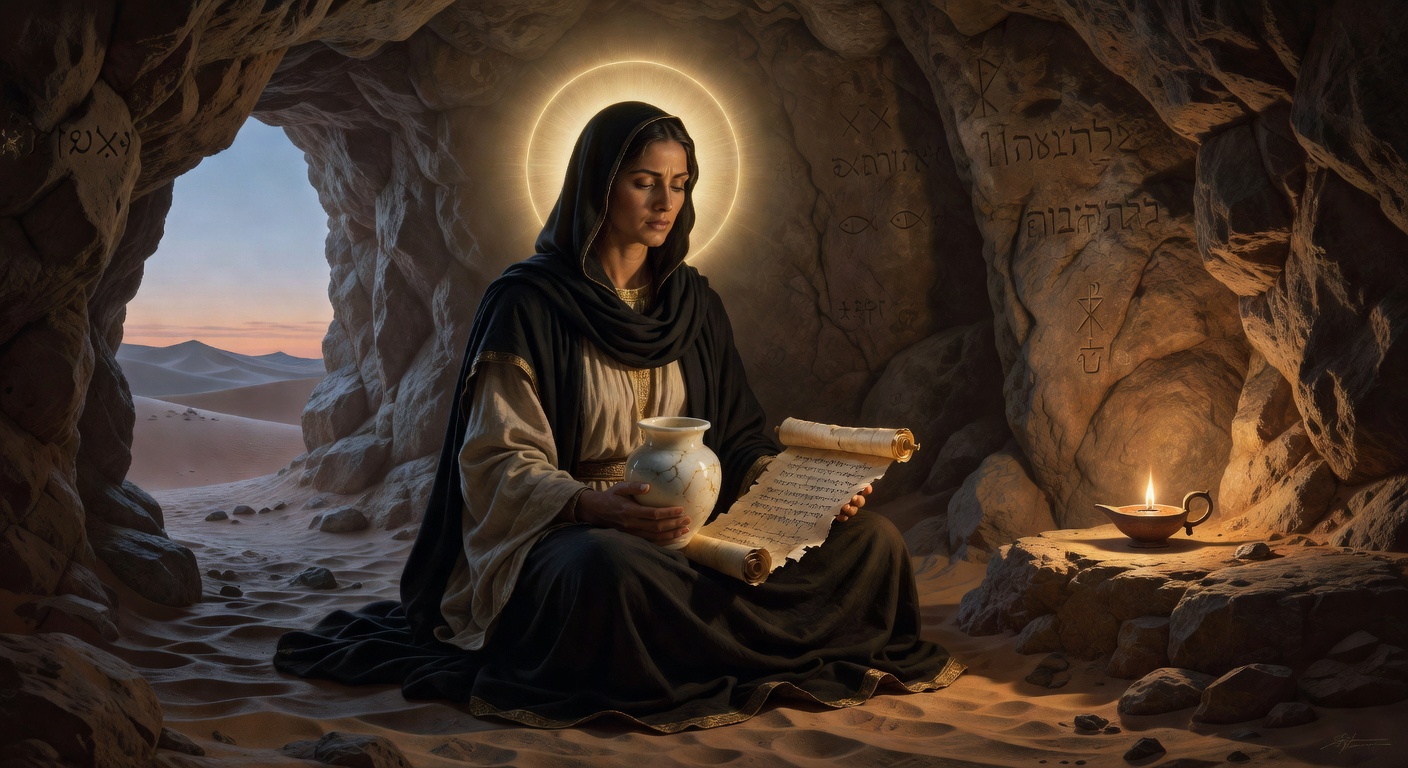
In the canonical gospels, Mary Magdalene appears briefly at the crucifixion and the empty tomb. In the Gnostic gospels, she is the primary disciple — the one to whom the risen Christ entrusts teachings the male apostles can’t yet receive. The Gospel of Philip (c. 250 CE) calls her Christ’s companion and says he loved her more than the other disciples. The Gospel of Mary (c. 150 CE) dramatizes her teaching the ascent of the soul through seven powers while Peter angrily protests that a woman couldn’t possibly have received what he didn’t.
The Church that won declared both gospels heretical and erased Mary’s teaching role. In 591, Pope Gregory conflated her with the unnamed sinner of Luke 7, turning the first apostle into a reformed prostitute for the next thirteen centuries. The Vatican only formally reversed this in 1969. The Nag Hammadi texts, recovered in 1945, tell a completely different story than the one the Church let us hear.
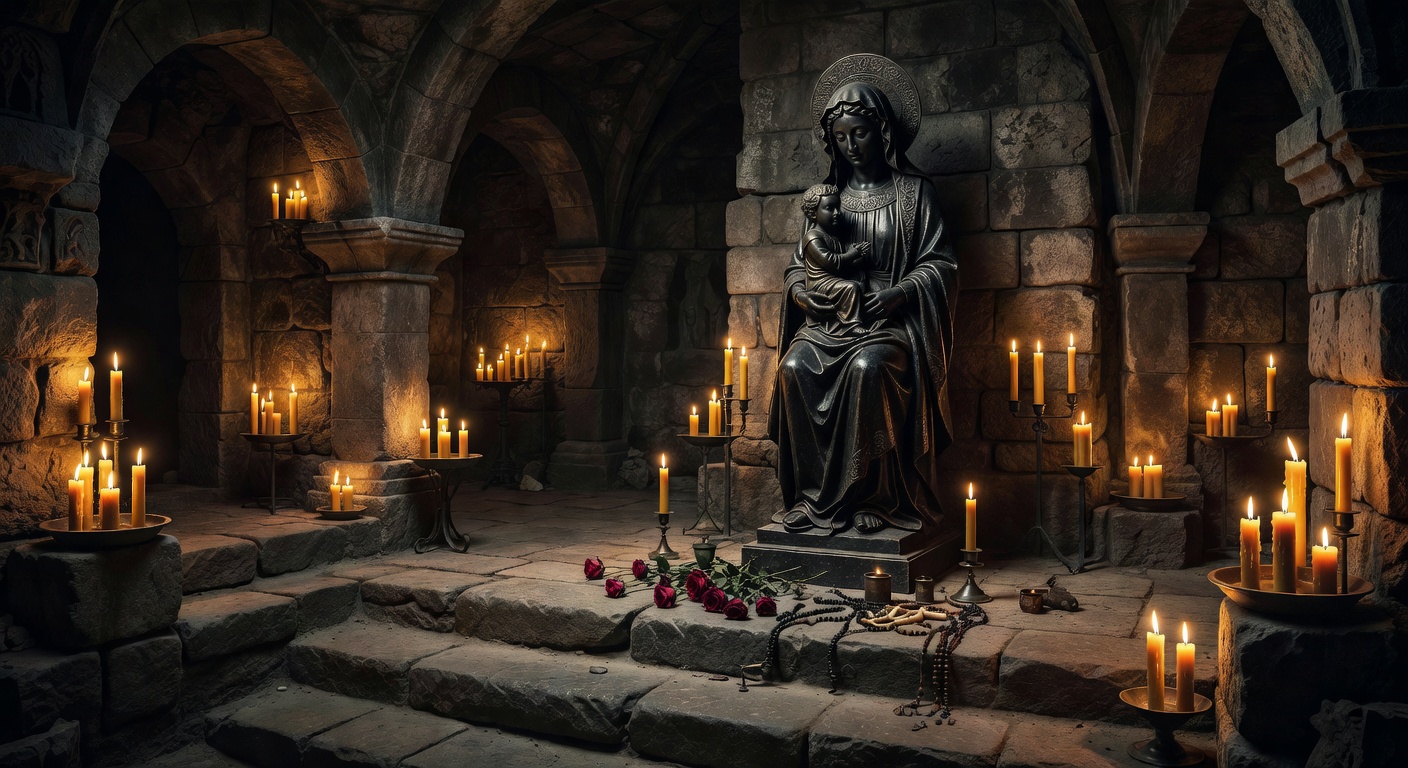
450 Statues, No Biblical Basis
The Black Madonnas — Where the Goddess Hid in Plain Sight
Across medieval Europe — Chartres, Montserrat, Częstochowa, Rocamadour, Le Puy — at least 450 statues of the Virgin Mary are rendered with dark black skin. No canonical text describes her that way. The statues are nevertheless specifically black, often carved from dark wood deliberately stained or painted, and they became the focus of some of Europe’s most intense pilgrimage traditions.
Chartres · France
Notre-Dame de Sous-Terre
The underground Black Madonna at Chartres Cathedral stands on the site of a pre-Christian sacred spring and, according to local tradition, an earlier statue venerated by Celts who called her Virgo Paritura — the virgin about to give birth.
Alexandria · Egypt
Isis — Queen of Heaven
Statues of Isis holding the child Horus predate Mary iconography by centuries and match the pose, iconography, and many specific attributes. When Christianity spread through Egypt, the existing Isis cult was not eradicated — it was reframed.
Ephesus · Turkey
Artemis/Diana → Mary
Ephesus was the home of the great temple to Artemis, one of the Seven Wonders. After Christianization, the city became a major Mary cult center and is where tradition places her final years. One goddess became the other on the same sacred ground.
Templar Connection
Who Brought the Black Back?
Many Black Madonnas appeared in Europe during or just after the Crusades (11th-13th centuries). The Knights Templar, returning from the Holy Land with forbidden knowledge, had a particular devotion to Black Madonnas. The connection is not coincidence.
The statues are dark for a reason nobody officially explains. They map the exact locations of older goddess cults. They became the holiest shrines of European Christianity. And the Church has never really been comfortable with them.
What was copied, what was native, and what the sources actually say
Frazer built the Osiris ↔ Jesus parallel. Jonathan Z. Smith tore it down (1987). Mettinger partially rebuilt it (2001). Seven candidates read carefully against the pre-Christian sources.
Rabbit hole detected
Deep dive →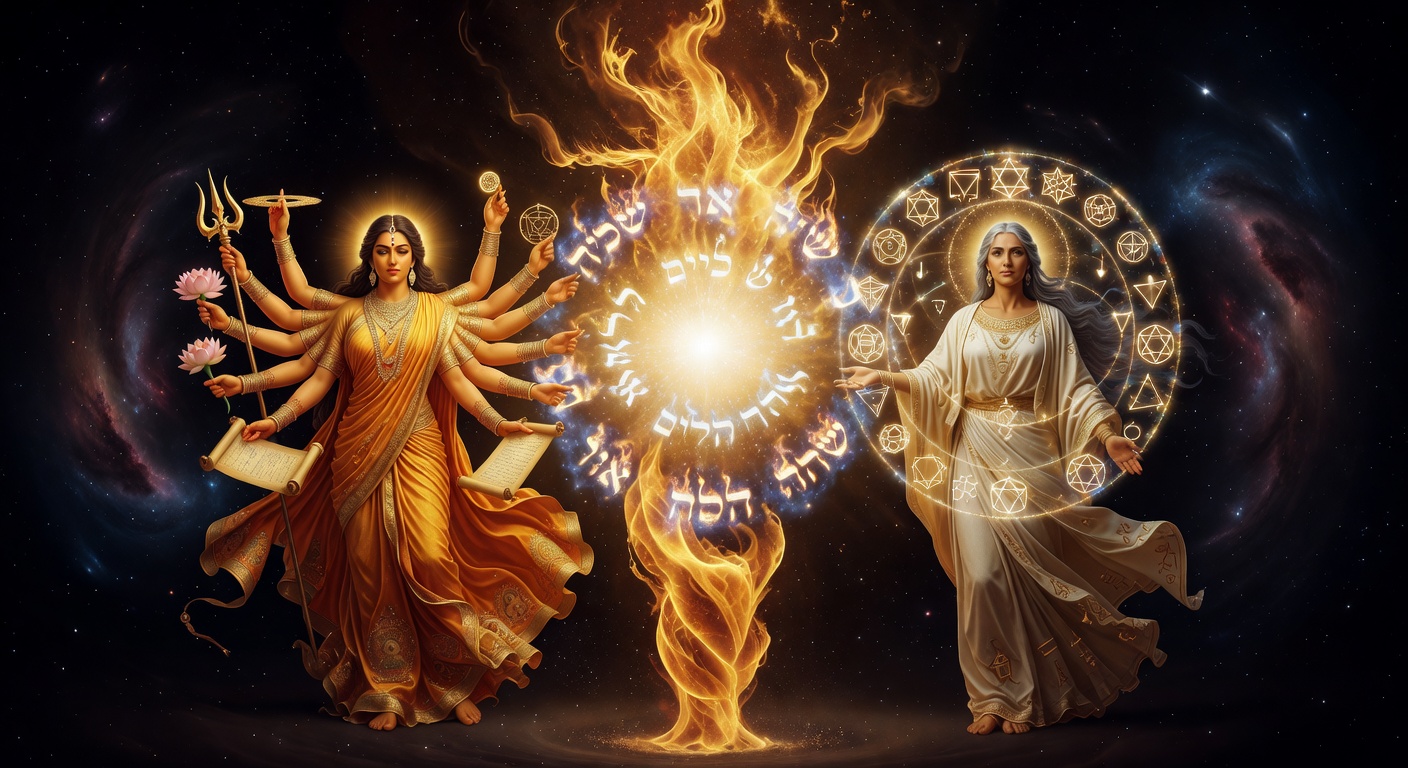
Three Names, One Principle
Shakti, Shekinah, Sophia
Shakti in Hindu Tantra is the cosmic power — without her, Shiva is an inert corpse. She is the active feminine that animates everything. Shekinah in Kabbalah is the divine presence that dwells with creation, the feminine aspect of God that was exiled when the Second Temple fell and whose return is the goal of mystical practice. Sophia in Gnostic cosmology is the fallen wisdom whose rescue is the entire point of salvation.
Three cultures that had limited contact. Three names. One structural claim: the divine feminine is in exile in the material world, and reality is incomplete until she is reintegrated. This is not the same as worshipping goddesses alongside gods. It is a deeper claim that reality itself has a feminine ground, and that the cosmos is wounded by her exile.
Six traditions, one recognisable figure
Isis, Shekinah, Sophia, Tara, Guanyin, Mary. Every tradition that runs on a male-only God smuggles her back in. Warner, Yü, Pagels, Scholem on the record.
Rabbit hole detected
Deep dive →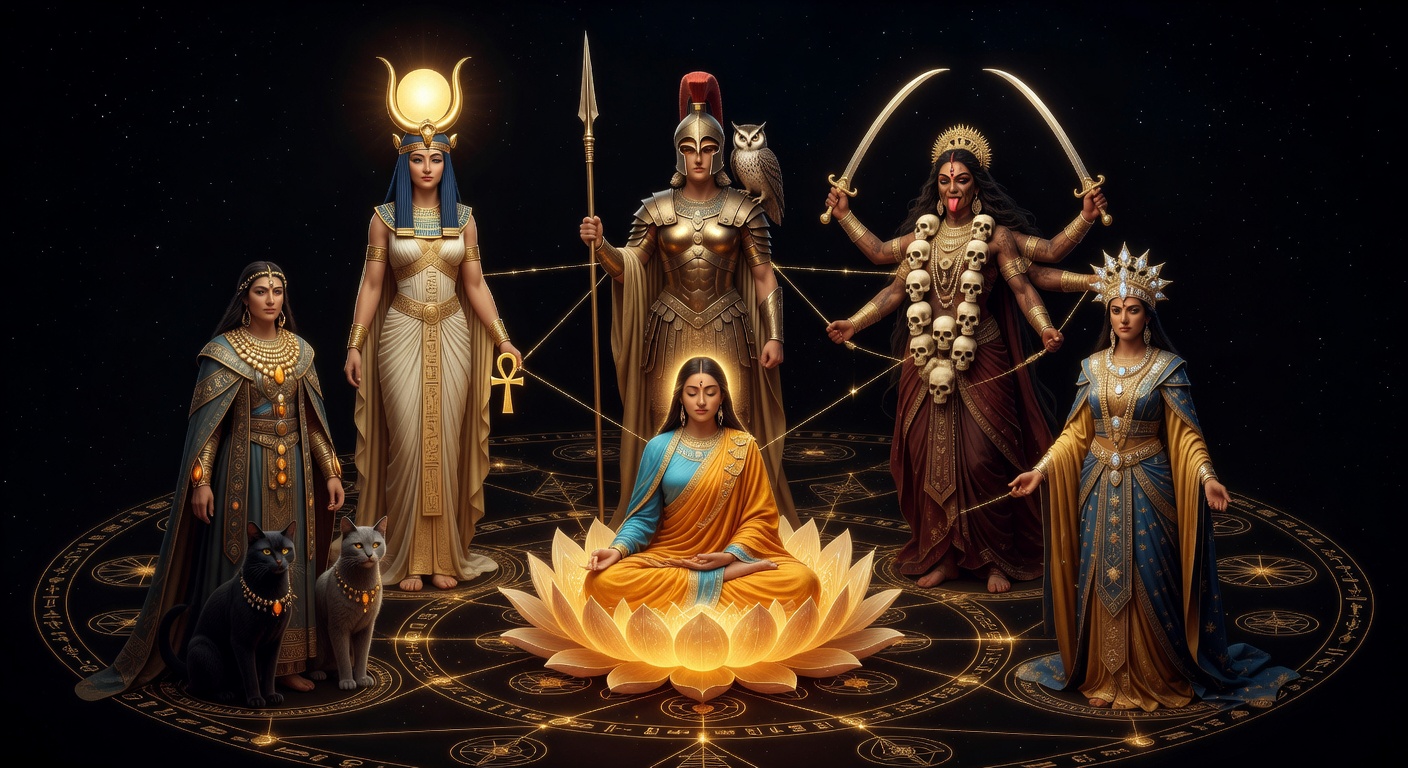
What Was Erased
Before the Father-Sky Gods Won
Pre-classical Mediterranean and Near Eastern religion was dense with goddess worship. Inanna in Sumer, the morning and evening star, queen of heaven. Ishtar in Babylon. Isis in Egypt, whose cult spread across the entire Roman Empire. Athena in Greece, born from Zeus’s head, patron of wisdom. Artemis of Ephesus. Cybele, the Phrygian Great Mother. Kali in India. Tara in Tibet. Freya and Frigg in the Norse world.
Then the Axial Age father-sky traditions came in — Yahweh, Ahura Mazda, eventually Allah and the Christian Trinity — and the goddesses were systematically demoted, demonised, or erased. Inanna became Lilith the demon. Isis was absorbed into Mary, then gradually stripped of her cosmic authority. Artemis’s temple was destroyed and replaced. The great priestesshoods of the ancient world ended within a few centuries.
This wasn’t accidental. The shift from gods-and-goddesses pantheons to men-only monotheism was a deliberate project, and it was violent. What we have left is the cleaned-up version — which is why the feminine keeps resurfacing as something just outside the official tradition. Too dangerous to include. Too real to erase.
The Honest Position
What the Evidence Shows
The feminine was central to ancient religion. That isn’t speculation — it’s sitting in the ground, documented across dozens of cultures and thousands of years of temples, statues, burials, and texts. The systematic demotion of the feminine in the monotheist traditions that came later is also documented. Neither half of that sentence is controversial among historians of religion.
What isn’t settled is what was lost when that happened. Was it just culture, or was there something the goddess traditions knew that the father-sky traditions forgot? The Gnostic rescue of Sophia, the Kabbalistic exile of Shekinah, the Tantric insistence that Shiva without Shakti is a corpse — none of that is random. It’s the wound the winning religions carry. And the Black Madonnas at Chartres and Montserrat are where the wound still leaks through.
Sources & Further Reading
- Gospel of Philip (c. 250 CE) — Gnostic text calling Mary Magdalene Christ’s companion
- Gospel of Mary (c. 150 CE) — Mary Magdalene teaching the ascent of the soul
- Black Madonnas — 450+ dark-skinned Virgin Mary statues across medieval Europe
- Sophia (Gnostic tradition) — the fallen divine feminine whose return redeems creation
- Shakti (Hindu Tantra) — the cosmic feminine power that animates all of reality
- Shekinah (Kabbalah) — the exiled feminine divine presence in Jewish mysticism
Part IV — The Persecuted Witness
The Forbidden History
The Gnostic Thread
What the earliest Christians actually believed. What the Crusaders uncovered in Jerusalem. Why the Church burned them for it. And where the knowledge went when it was driven underground.
1st – 4th Century CE
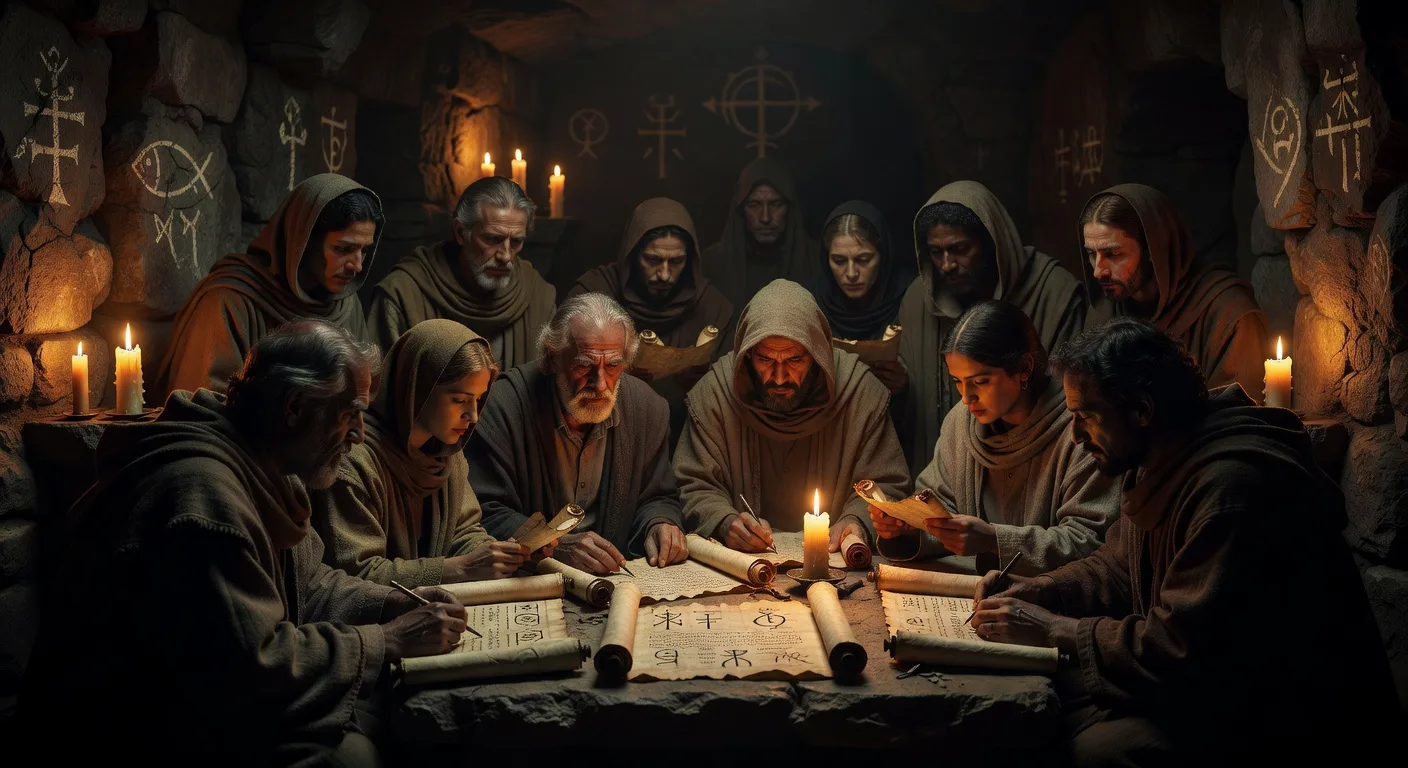
The Original Christians Were Gnostics
Before Christianity was the state religion of Rome, there was no single “Christianity.” There were dozens of competing traditions, and many of the earliest — arguably the original ones — were Gnostic. They did not worship a god in the sky and wait for salvation. They practised gnosis: direct, personal, experiential knowledge of the divine.
The Gnostics taught that the material world was created by a lesser deity — the Demiurge — and that each human contained a divine spark, a fragment of the true God trapped inside flesh. Salvation was not about faith or obedience. It was about waking up — recognising that you are a spiritual being imprisoned in matter, and that the institutions claiming to connect you to God are part of the prison, not the exit.
The key Gnostic texts include the Gospel of Thomas (114 sayings of Jesus with no crucifixion narrative — pure wisdom teaching), the Gospel of Philip, the Apocryphon of John, and the Pistis Sophia. Across them, Jesus teaches that the Kingdom of God is within you: not in a church, not after death, but reachable right now through inner knowing.
This was the original message. And it was a direct threat to anyone who wanted to build a power structure between humans and the divine.
325 CE — The Council of Nicaea
Rome Chose Which Christianity Survives
In 325 CE, Emperor Constantine convened the Council of Nicaea — not as a spiritual leader, but as a political strategist. The Roman Empire was fracturing. Constantine needed one unified religion to hold it together. He did not care which version was true. He cared which version was controllable.
The Gnostic traditions — with their emphasis on personal revelation, no need for priests, and the radical claim that the god of this world was a false god — were politically useless to an empire. You cannot run an empire on a religion that tells people they do not need authority figures. So the Nicene Creed was established, four canonical gospels were selected (Matthew, Mark, Luke, John), and everything else was declared heresy.
The purge was systematic. In 367 CE, Bishop Athanasius of Alexandria issued an Easter letter ordering all “heretical” texts destroyed. Monks and followers were given a choice: convert to Orthodox Christianity or face persecution. Gnostic gospels were burned across the empire. Communities were disbanded. Teachers were killed or driven underground.
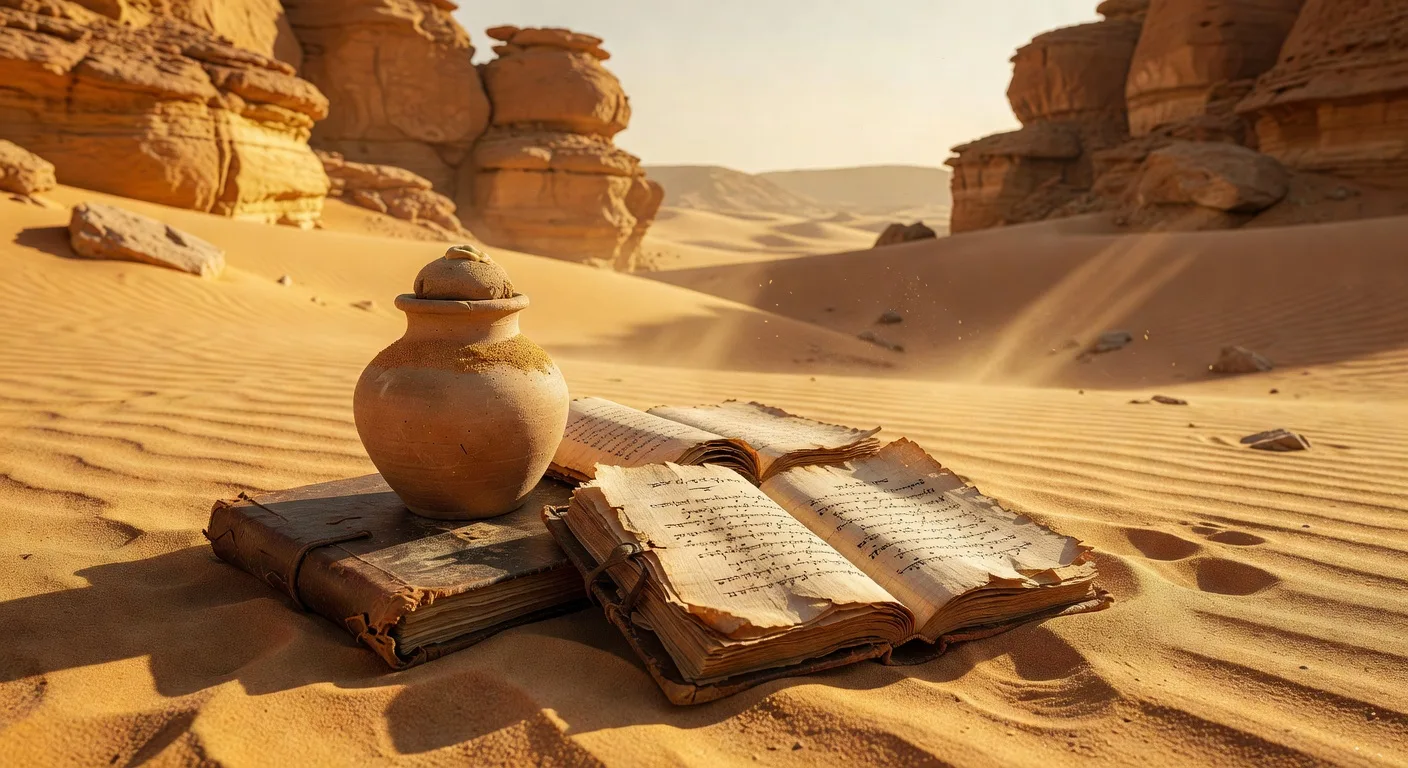
Some refused to let the knowledge die. In upper Egypt, near a town called Nag Hammadi, someone sealed 52 Gnostic texts in a clay jar and buried them in the desert. They stayed there for more than 1,600 years.
1945 — Nag Hammadi, Egypt
The Buried Truth Returns
In December 1945, a farmer named Muhammad Ali al-Samman was digging for fertiliser near the cliffs of Nag Hammadi when his mattock hit a sealed red clay jar. Inside were 13 leather-bound papyrus codices — 52 texts in Coptic that the Church had tried to erase from history 1,600 years earlier.
These texts — now known as the Nag Hammadi Library — tell a radically different story of Christianity. The Gospel of Thomas records 114 sayings of Jesus with no miracles, no resurrection narrative, no church hierarchy — just direct spiritual instruction. The Gospel of Philip describes Jesus’s relationship with Mary Magdalene and frames her as his closest disciple. The Apocryphon of John lays out the full Gnostic cosmology: the Demiurge, the Archons, the divine spark.
These were not fringe writings. They were the scriptures of the original Christian movement, hidden by believers who knew that Rome would destroy them, preserved for a future generation that might be ready to hear what the Church had silenced.
48 BCE – 642 CE
The Libraries They Burned
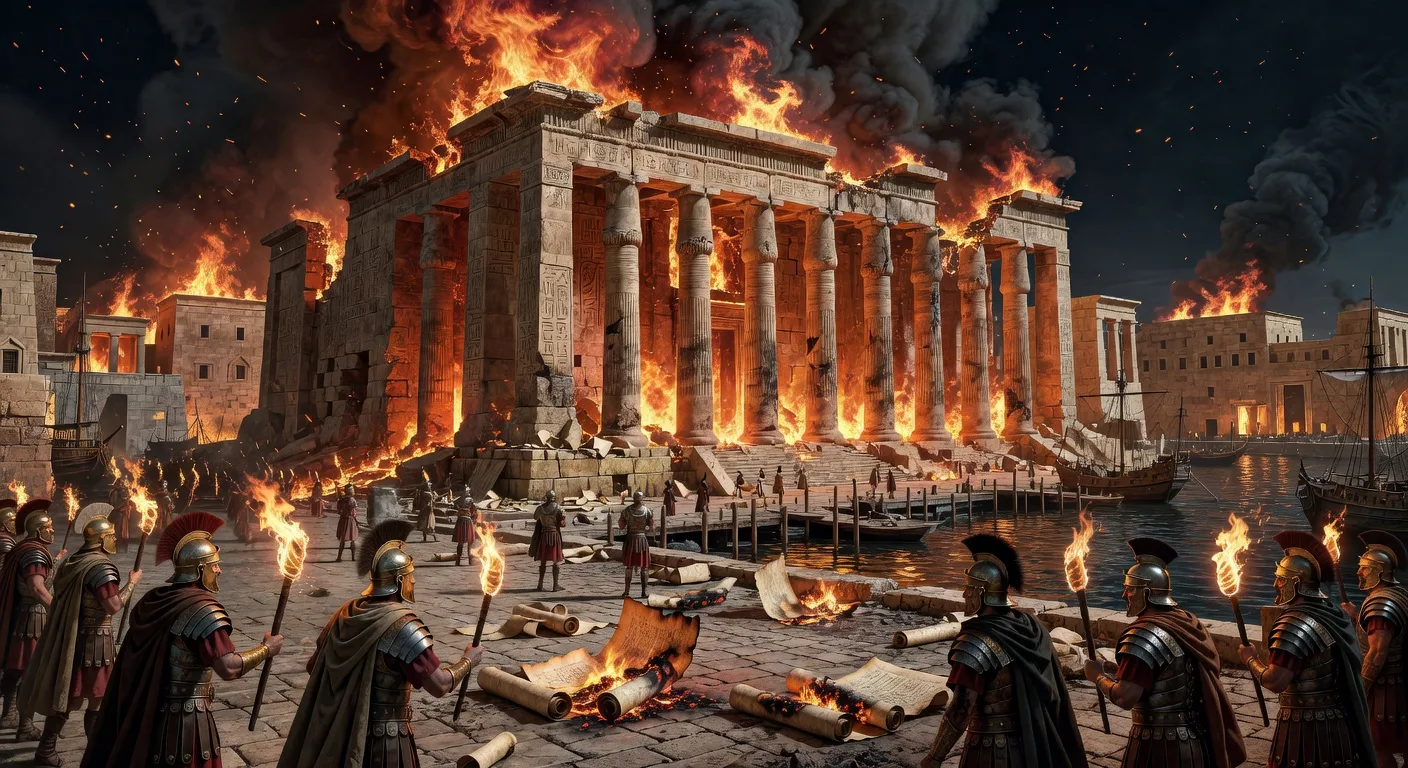
Ancient Egypt was the world’s knowledge vault. Alexandria alone housed three major centres of learning: the Great Library of Alexandria (the Mouseion), the Serapeum (Temple of Serapis with its daughter library), and the Royal Library attached to the Bruchion palace complex. Together they held an estimated 400,000 to 700,000 scrolls — the accumulated knowledge of the ancient world.
The destruction came in waves. In 48 BCE, Julius Caesar’s forces set fire to ships in Alexandria’s harbour during the civil war. The fire spread to the docks and warehouses, destroying an estimated 40,000 scrolls stored for export. Caesar himself acknowledged the loss, though he downplayed it. Plutarch and Strabo both recorded that the library suffered catastrophic damage.
Then in 391 CE, Emperor Theodosius I — the man who made Christianity the only legal religion of Rome — ordered the destruction of all pagan temples. Bishop Theophilus of Alexandria personally led the mob that demolished the Serapeum, the last surviving major library. Scrolls that were not burned were scattered and lost. Mathematics, astronomy, medicine, philosophy, engineering, the mystery traditions — gone.
What happened to the scrolls that did survive — the ones deemed valuable enough to keep rather than burn? Many researchers think the answer is under Vatican City.
53 Miles of Shelving
What the Vatican Won't Release
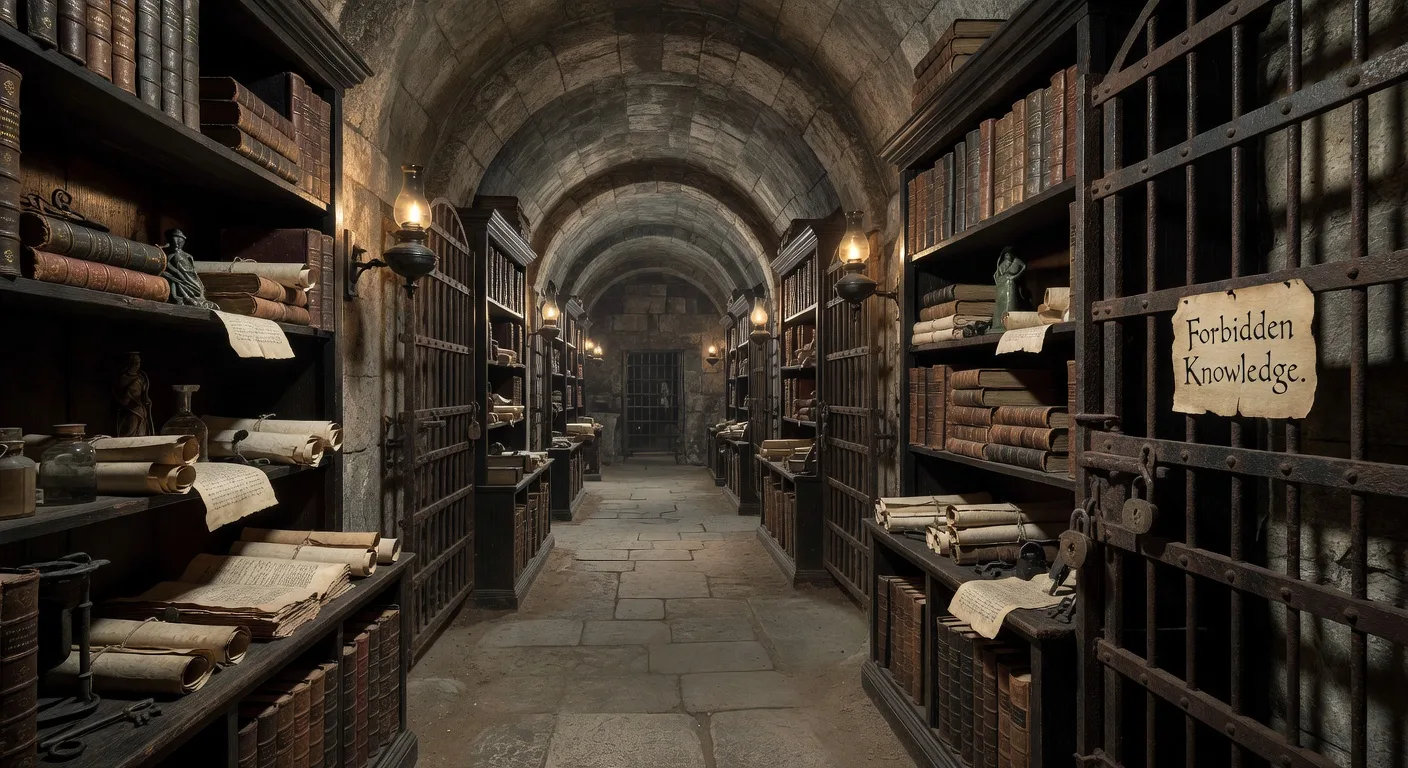
The Vatican Apostolic Archive (renamed from “Secret Archive” in 2019 — a rebrand, not an opening) holds an estimated 53 miles of shelving spanning over twelve centuries of documents, manuscripts, and artifacts. Access is granted only to qualified researchers with specific, pre-approved topics. There is no public catalogue. No one outside the Vatican knows the full extent of what is in there.
What we do know: the archive holds papal correspondence going back to the 8th century, Inquisition trial records (including the trial of Galileo and the Knights Templar), and documents from virtually every culture the Church has encountered over two thousand years. When Rome conquered Egypt, when the Crusaders sacked Constantinople, when the Spanish looted Mesoamerica — artifacts, codices, and manuscripts were shipped back to Rome.
Egyptian obelisks stand in St. Peter’s Square. Egyptian artifacts fill the Vatican Museums. The Church did not destroy everything — it kept what it found valuable and locked it away. Pre-Christian material on the nature of reality, cosmology, consciousness, and the divine — material that could undermine the Church’s claim to be the sole mediator between humanity and God — is still behind closed doors.
The question is not whether the Vatican has ancient knowledge. It is why they will not let the rest of us see it.
1119 – 1312 CE
The Knights Templar — What They Found Under Solomon's Temple
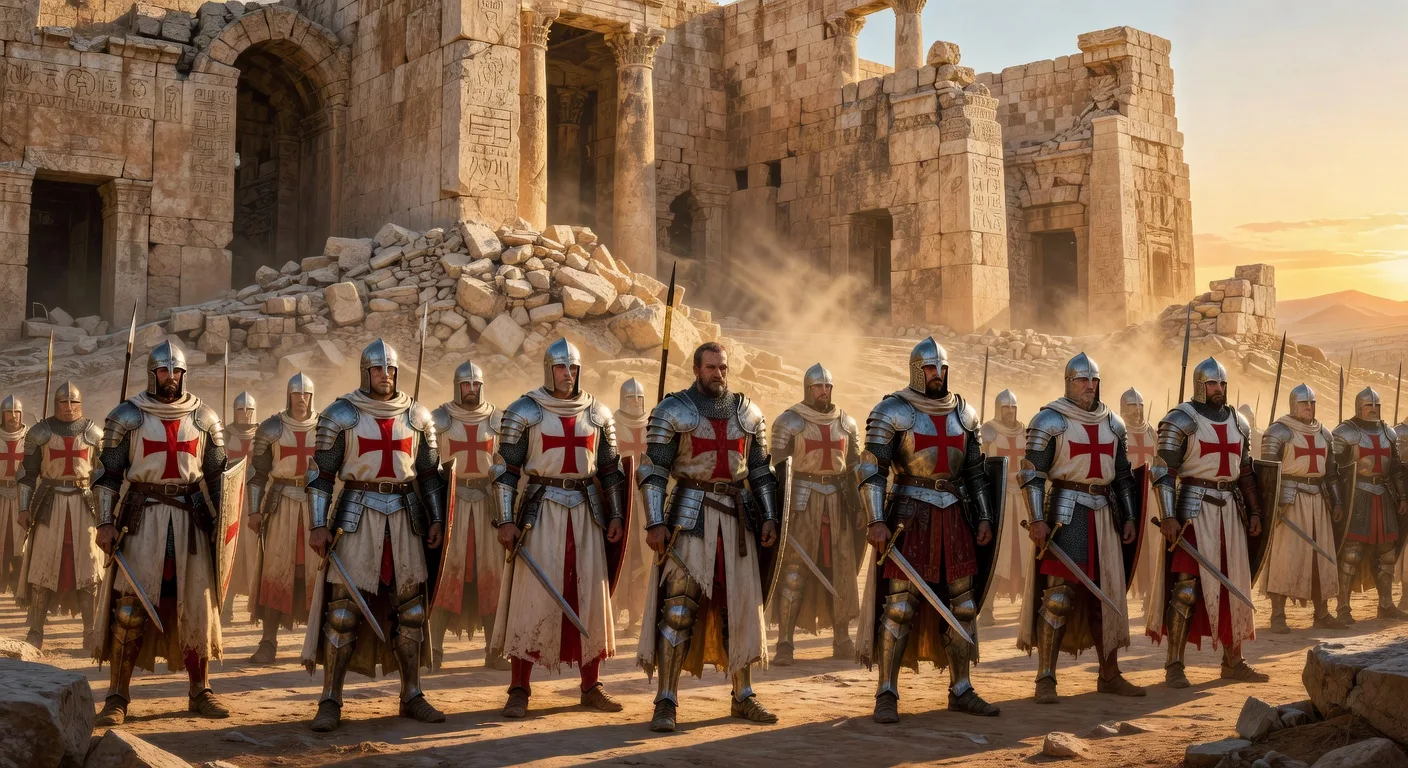
In 1119 CE, nine French knights led by Hugues de Payens arrived in Jerusalem and made an unusual request to King Baldwin II: to be housed inside the Al-Aqsa Mosque, sitting directly on the ruins of Solomon’s Temple. Their stated mission was to protect Christian pilgrims on the roads. Nine knights cannot protect hundreds of miles of road. Something else was going on.
For the next nine years, the founding Templars accepted no new members and ran extensive excavations beneath the Temple Mount. In 1867, British Royal Engineers led by Lieutenant Charles Warren rediscovered the Templar tunnels running deep under the mount — confirming the excavation physically. What the Templars found in there, the record does not say. But the trajectory afterwards speaks for itself.
Before the excavation: nine obscure knights with nothing. After: the most powerful military and financial organisation in the Western world. Within decades they had direct papal backing (Papal Bull Omne Datum Optimum, 1139, exempted them from all authority except the Pope), a network of over 9,000 properties across Europe, and a system of cross-border promissory notes that effectively invented international banking — a pilgrim could deposit money in London and withdraw it in Jerusalem.
They also came back from the East with something that changed their theology. The Templars began embedding sacred geometry, Kabbalistic symbolism, and Gnostic ideas into their architecture and rituals. Their round churches — like Temple Church in London — were modelled not on Roman basilicas but on the Church of the Holy Sepulchre and ultimately on pre-Christian sacred geometry. They had met the ancient knowledge, and it changed them.
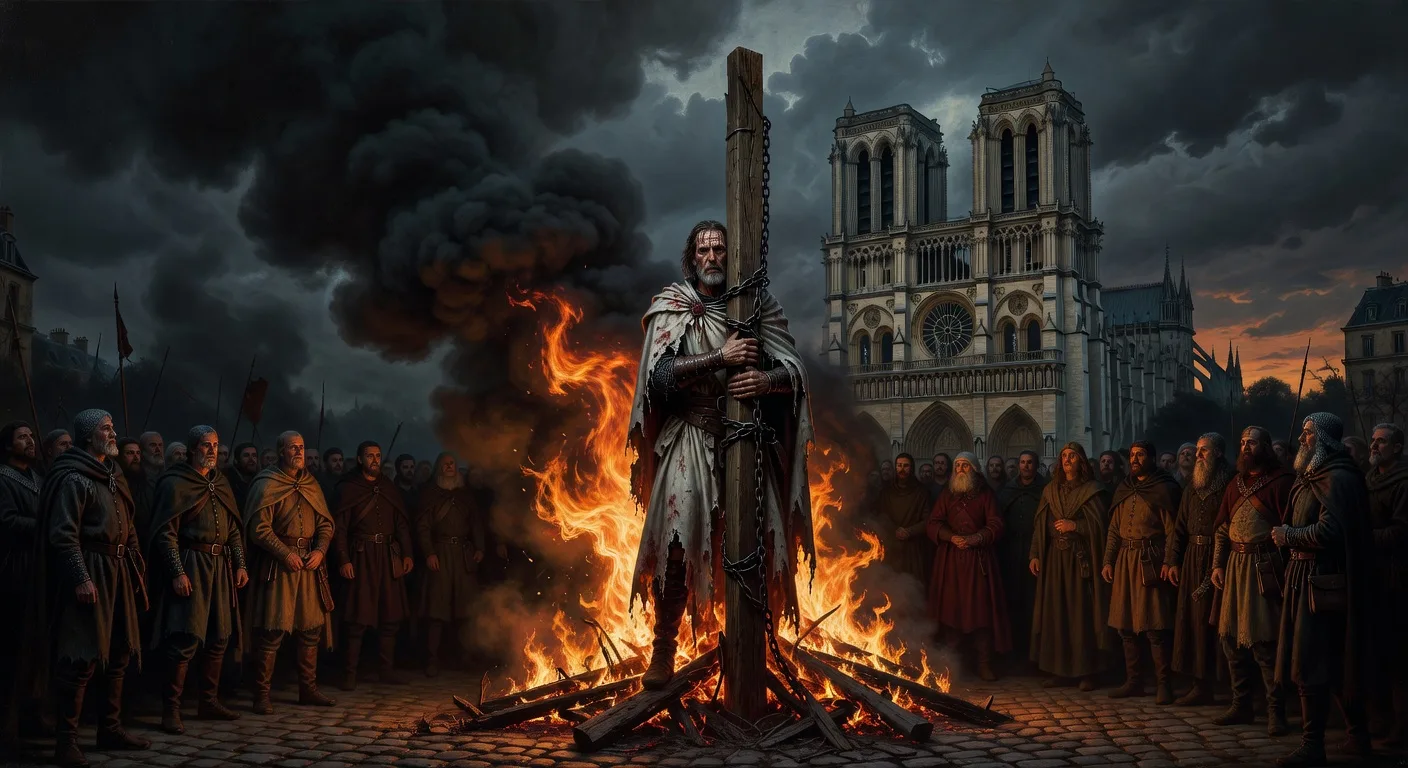
Friday, October 13, 1307
The Day the Church Burned Its Own Knights
King Philip IV of France was deeply in debt to the Templars — and deeply threatened by their independence. On Friday, 13 October 1307 (one popular origin story for the “Friday the 13th” superstition — most folklorists trace it elsewhere), he launched a coordinated dawn raid across France. Thousands of Templars were arrested simultaneously on charges of heresy, blasphemy, and secret ritual.
The charges were revealing: denying Christ, spitting on the cross, worshipping a mysterious head called Baphomet, practising secret initiation rites. Under torture by the Inquisition, many confessed — and later recanted, saying the confessions had been forced. The Church did not care. In 1312, Pope Clement V dissolved the order under pressure from Philip.
On 18 March 1314, the last Grand Master, Jacques de Molay, was burned alive on an island in the Seine, within sight of Notre-Dame. According to contemporary accounts, as the flames rose, de Molay called out a curse, summoning both Pope Clement V and King Philip IV to meet him before God within the year. Pope Clement died 33 days later. Philip died 8 months after that.
But the Church made a critical miscalculation. They thought that destroying the order would destroy the knowledge. They were wrong. The Templars had been warned. Templar legend holds that their fleet — 18 ships — vanished from the port of La Rochelle the night before the arrests; no primary source documents the departure, but the ships are not listed afterwards either. Wherever they went, the knowledge went with them.
14th – 18th Century
Going Underground — The Birth of the Secret Societies
After 1314 the surviving Templars could not simply vanish — they were a network of thousands across Europe. They did what any persecuted knowledge tradition does. They went underground, and embedded their teachings inside organisations the Church could not easily attack.
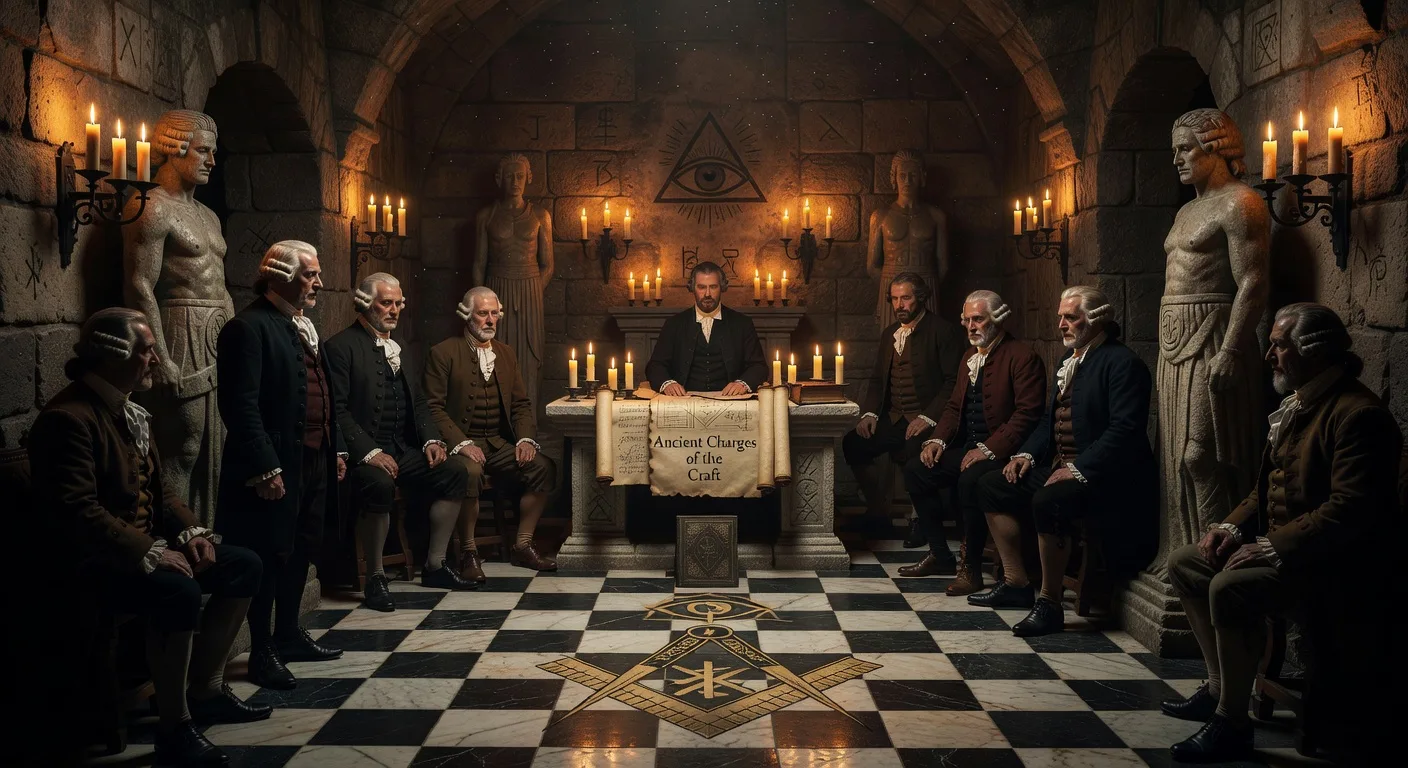
In Scotland, Templars found refuge under King Robert the Bruce, who was already excommunicated and had nothing to lose. Templar knights fought alongside the Scots at the Battle of Bannockburn in 1314. Scotland became a safe haven, and the Templar tradition merged with the emerging stonemason guilds — craftsmen who built the great cathedrals and carried their own body of sacred-geometry knowledge. That merger is widely believed to be the origin of Freemasonry.
In Portugal, King Denis simply renamed the Templars the Order of Christ and let them keep operating openly. In Germany, Templar assets were absorbed by the Teutonic Knights. Across Europe the knowledge fragmented into parallel streams: the Rosicrucians (surfacing publicly in 1614 with their mysterious manifestos), the Knights of Malta, various Hermetic orders, and ultimately the Freemasons, who would help shape the modern world from the inside.
The symbols tell the story. Masonic lodges still use the two pillars (Boaz and Jachin — from Solomon's Temple), the checkered floor (duality — the Gnostic interplay of light and dark), the all-seeing eye (the divine spark / gnosis), and compass and square (sacred geometry). These aren't decorations. They're the surviving language of a suppressed tradition — hiding in plain sight for 700 years.
1492 — Under a False Flag
Columbus Sailed Under the Templar Cross
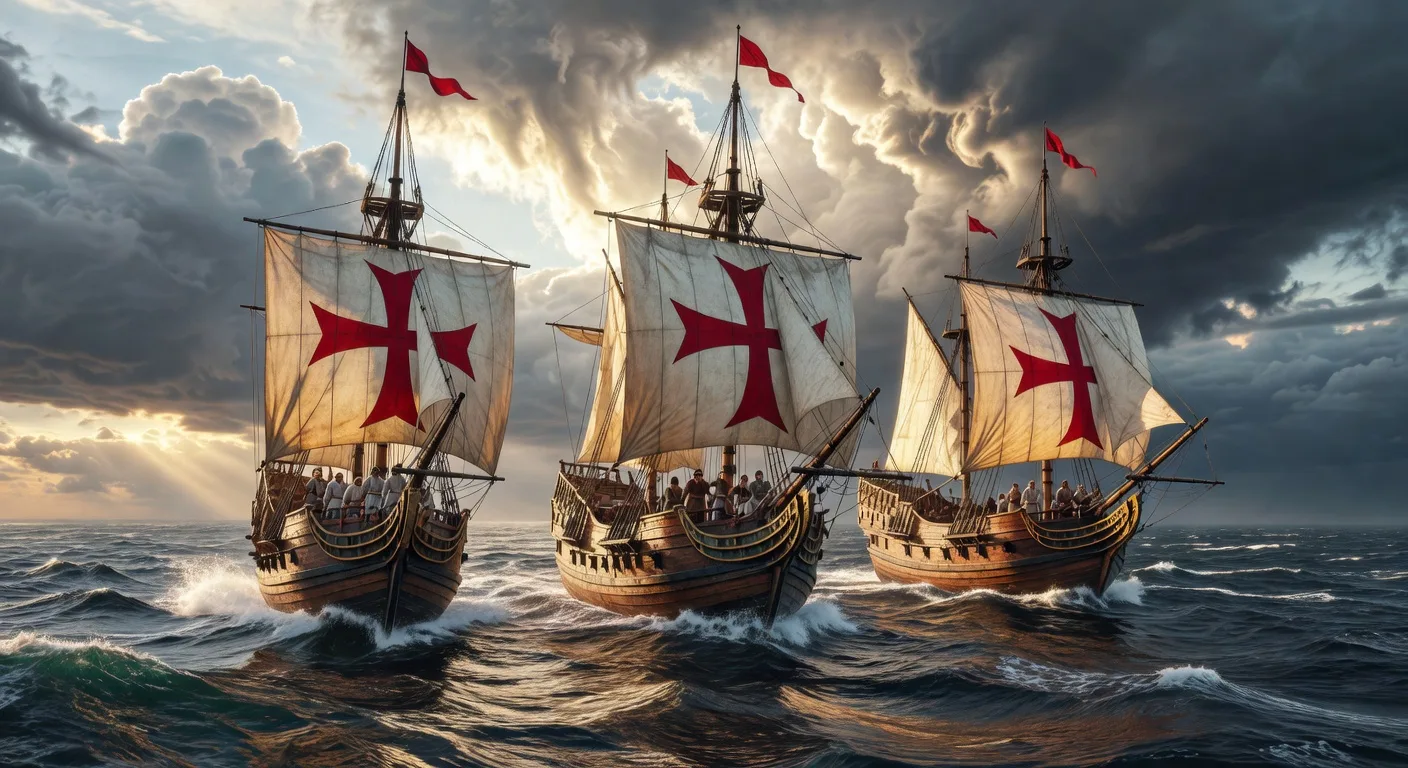
Look at almost any period painting of Columbus’s 1492 voyage and you see it: the sails of the Niña, Pinta, and Santa María carry the red cross pattée — the unmistakable mark of the Knights Templar. Not a generic Christian cross. The specific Templar cross.
That was not an artistic flourish. Columbus’s voyage was funded and organised under the patronage of the Order of Christ — the Portuguese continuation of the Knights Templar. Columbus’s father-in-law, Bartolomeu Perestrelo, was a Knight of the Order of Christ. Columbus himself had access to the Order’s maritime charts and navigational knowledge — charts that, according to Portuguese naval historians, already showed lands to the west long before 1492.
The Order of Christ was the engine of Portugal’s entire Age of Exploration. Prince Henry the Navigator — the patron of European deep-water expansion — was the Order’s Grand Master. Every Portuguese ship that sailed down the African coast and eventually around to India carried the Templar cross on its sails.
Columbus did not “discover” America by accident. He sailed under a Templar flag, using Templar maps, funded by a Templar successor order. The “New World” was the Templar endgame — a continent beyond the Vatican’s reach where the old knowledge could, in principle, be practised freely. Whether any of that original vision survived the conquest that followed is an entirely different story.
The Thread That Wouldn't Break
Follow the thread. The Gnostics taught that you contain the divine — no priest required. Rome crushed them and burned the texts. The knowledge survived in the mystery schools of Egypt and the Middle East. The Templars found some of it under Solomon’s Temple and brought it back to Europe. The Church burned them too. The survivors went underground, becoming Freemasons, Rosicrucians, and Hermetic orders. They encoded the knowledge in architecture, symbolism, and ritual. Columbus sailed under their flag to a new continent.
Meanwhile, the Vatican sits on 53 miles of ancient documents it will not release. The Library of Alexandria — humanity’s greatest collection of knowledge — was burned by the Romans and finished off by the Church. The Cathars, who taught the same Gnostic dualism in 12th-century France, were wiped out in the Albigensian Crusade — by some estimates hundreds of thousands massacred. At the siege of Béziers in 1209, when the crusaders asked the Papal legate how to distinguish Cathars from Catholics, his reported answer: “Kill them all. God will know his own.”
Every time this idea surfaces — that you are divine, that you do not need intermediaries, that the material world is a construct designed to keep you asleep — the power structures mobilise to destroy it. Every. Single. Time. The question worth sitting with: why is this idea so dangerous to them?
Sources & Further Reading
- Gospel of Thomas — 114 sayings of Jesus with no crucifixion narrative, pure wisdom teaching
- Council of Nicaea (325 CE) — where Constantine chose which Christianity would survive
- Nag Hammadi Library (discovered 1945) — 52 Gnostic texts buried in Egypt, hidden for 1,600 years
- Library of Alexandria — the ancient world’s greatest knowledge vault, destroyed in waves
- Vatican Apostolic Archive — 53 miles of shelving, no public catalog
- Knights Templar (1119–1312) — from nine knights under Solomon’s Temple to the most powerful order in the West
- Albigensian Crusade (1209–1229) — the extermination of the Cathar Gnostic revival in southern France
- Order of Christ (Portugal) — the Templar successor order behind the Age of Exploration
The Pattern
What It All Keeps Coming Back To
These texts span thousands of years, several continents, and cultures that never met. Strip the local language and the same handful of claims keep surfacing. Most of them aren’t loose — they’re specific enough that we’ve now mapped each one in detail elsewhere on the site. Cards with a gold ring go to a full pattern exploration.
A great flood ended a previous world
Over 200 cultures, every inhabited continent, the same core story. Sumer’s Ziusudra, India’s Manu, Greece’s Deucalion, the Popol Vuh, Aboriginal coastal memory going back 7,000 years. Geology agrees the climate did flip, hard, around 12,900 years ago.
Deep dive →
Time runs in great circles, not straight lines
Hindu yugas, Mayan suns, Norse ages, Greek aeons. And the same precessional numbers — 72, 432, 2,160, 25,920 — keep turning up in cultures that had no way to share notes.
Deep dive →
Consciousness is the substrate, not a side effect
What the Upanishads said. What Buddhism kept refining. What Eckhart and Zen circled from opposite sides of the world. What twentieth-century physics keeps half-saying. Schrödinger cited the Upanishads by name.
Deep dive →
A god who dies and returns
Osiris, Tammuz, Dionysus, Attis, Adonis, Baldr, Jesus. Frazer called it one pattern. Jonathan Z. Smith said no. Mettinger said yes, partly. The fight is a hundred years old and still live.
Deep dive →
Reality is built out of information, not stuff
“In the beginning was the Word.” The I Ching as 64 binary numbers. Pythagoras’s “all is number.” Wheeler’s “it from bit.” The holographic principle. Leibniz spotted the binary in the I Ching 245 years before Shannon formalised the bit.
Deep dive →
The divine feminine keeps coming back
Isis, Shekinah, Sophia, Tara, Guanyin, Mary. Six traditions that never met, one recognisable figure. Every religion that tries to run on a male-only God ends up smuggling the merciful feminine mediator back in.
Deep dive →
Teacher-beings restart knowledge after the flood
Oannes from the Persian Gulf, half-fish half-man, teaching writing and law to Sumer. Thoth in Egypt. Quetzalcoatl in Mexico. Viracocha in the Andes. After the catastrophe, somebody arrives to bring civilisation back — and they don’t look local.
A future pattern exploration. Have a source we should look at? Send it →
Either every culture independently invented the same set of stories — or they were remembering the same events. The second reading is simpler than the first.
The geometry and the stones tell the same story in a different alphabet. Go deeper →
The Library
The Full Library Lives with the Oracle
The 128 source texts the Oracle reads from — sacred scripture, alternative archaeology, modern physics, consciousness research — live on the Oracle page, right below the Q&A interface. Browse them, read the originals, or ask the Oracle about any of them.
Browse the Library on the Oracle pageThese texts are not presented here as literal truth, and not dismissed as mere myth. They are read for what they may actually be: the encoded memories of a species that has been through this before.